
Showing posts with label #1 - Landscapes in Change: reflections. Show all posts
Showing posts with label #1 - Landscapes in Change: reflections. Show all posts
Sunday, October 9, 2011

Tuesday, September 20, 2011
reflections

On this nine days trip around the Arctic Norway and Russia there were a lot of strong feelings that emanated through my mind and body. We went to many different places with different qualities. We met various people that live in these spaces, and they all have widely differing backgrounds and beliefs about this landscape and how to inhabit these spaces.
What struck me on this trip was how far the city-planning have gone from planning for the people that inhabit these places and how it focuses more and more on planning around big industry and economical growth. I felt like the industry had taken over a big part of this region, and even the people living there could often just see future in these big industries.
We were so lucky to meet with wonderful people in Vardø, Hamningber, Kirkenes and Murmansk that I felt were doing some extraordinary work with the sense of engagement within a multiplicity. Doreen Massey talks about it in the book For Space: “If time unfolds as change then space unfolds as interaction. In that sence space is the social dimension. Not in the sense of exclusivety human sociability, but in the sence of engagement within a multiplicity.”
I asked myself many times on this trip where the western part of the world had taken the wrong turn and if there is no turning back from this obsession on industry and mass-production?
Is that the only way to move forward?
Does these industries and their architecture embody some kind of beauty?
What happens when they are left behind does the nature take over and wove them into its arms?
At the same time these places made me feel sad, I felt the raw industrial environment was stimulating in some odd way. Juhani Pallasmaa talks about how buildings and cities are instruments and museums of time, how they enable us to see and understand the passing of history, and to participate in time cycles that surpass individual life. Does this industrial architecture connect us with history, where trough buildings we are able to imagine the bustle of the old street? Does time stand firmly still in these structures? What kind of opportunities are there to find in these spaces and how can I work with the enviorment and the local people to make them visible?
Understanding Space

Reflections from a trans-arctic journey
When reflecting over the experiences gained from a diverse and fascinating journey through an area that is both an extreme periphery and the center of the world at the same time I find my self looking for a common denominator for the whole region. What it it that they all have in common expect for the geographical location to the North. This might be the proximity to resources, but this is not true for all the places we've visited. What we did see in all the places we visited were resourceful people who were able to make innovative change with limited resources. Talented local politicians in Alta, birdwatching architects in Vardø, Pikene på Broen in Kirkenes and Mr. Pink, the first youth club in the ground floor of a anonymous housing block in Murmansk. If I was going to point or one thing they all have in common is a competence of innovation and improvisation. This is the same ability Joar describe in the spatial practices that can be observed in the intricate system conceived in the gardens of the Sami population. These innovations can also be described as different uses and conceptions of space in the definition of space by Doreen Massey.
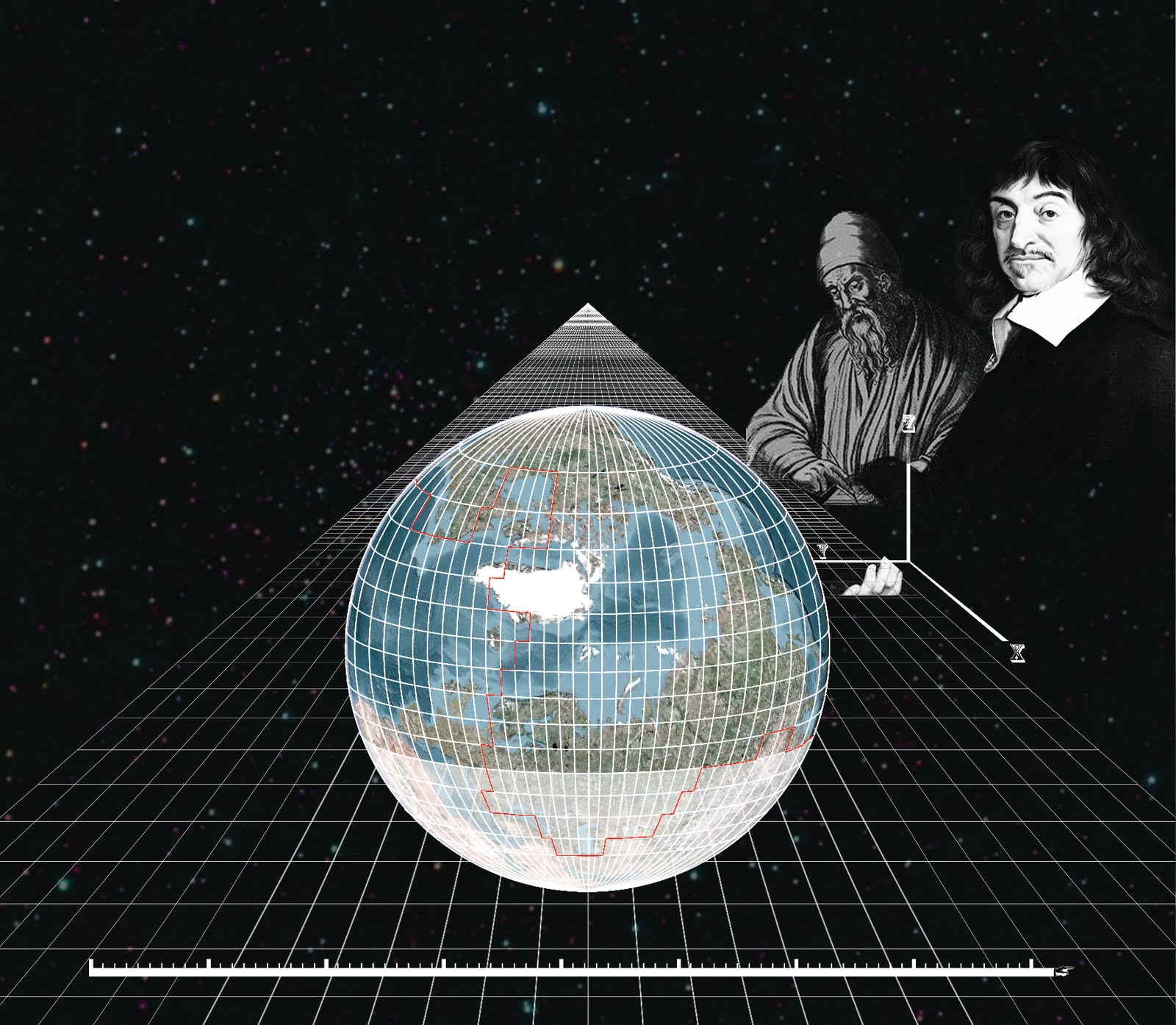 The contested understanding of space as the surface where
places, peoples, cultures and phenomena simply exist.
"...first, that we recognize space as the product of interrelations; as constituted through interactions, from the immensity of the global to the intimately tiny.
Second; that we understand space as the sphere of possibility of the existence of multiplicity in the sense of contemporaneous plurality; as the sphere in which distinct trajectories coexist, as the sphere of coexisting heterogeneity. Without space, no multiplicity; without multiplicity; no space.
Third, that we recognize space as always under construction. Precisely because space on this reading is a product on relations-between, relations that are necessarily embedded material practices which have to be carried out, it always in the process of being made. It is never finished; never closed. Perhaps we can imagine space as simultaneity of stories-so-far."
Doreen Massey, on the assumptions of Space
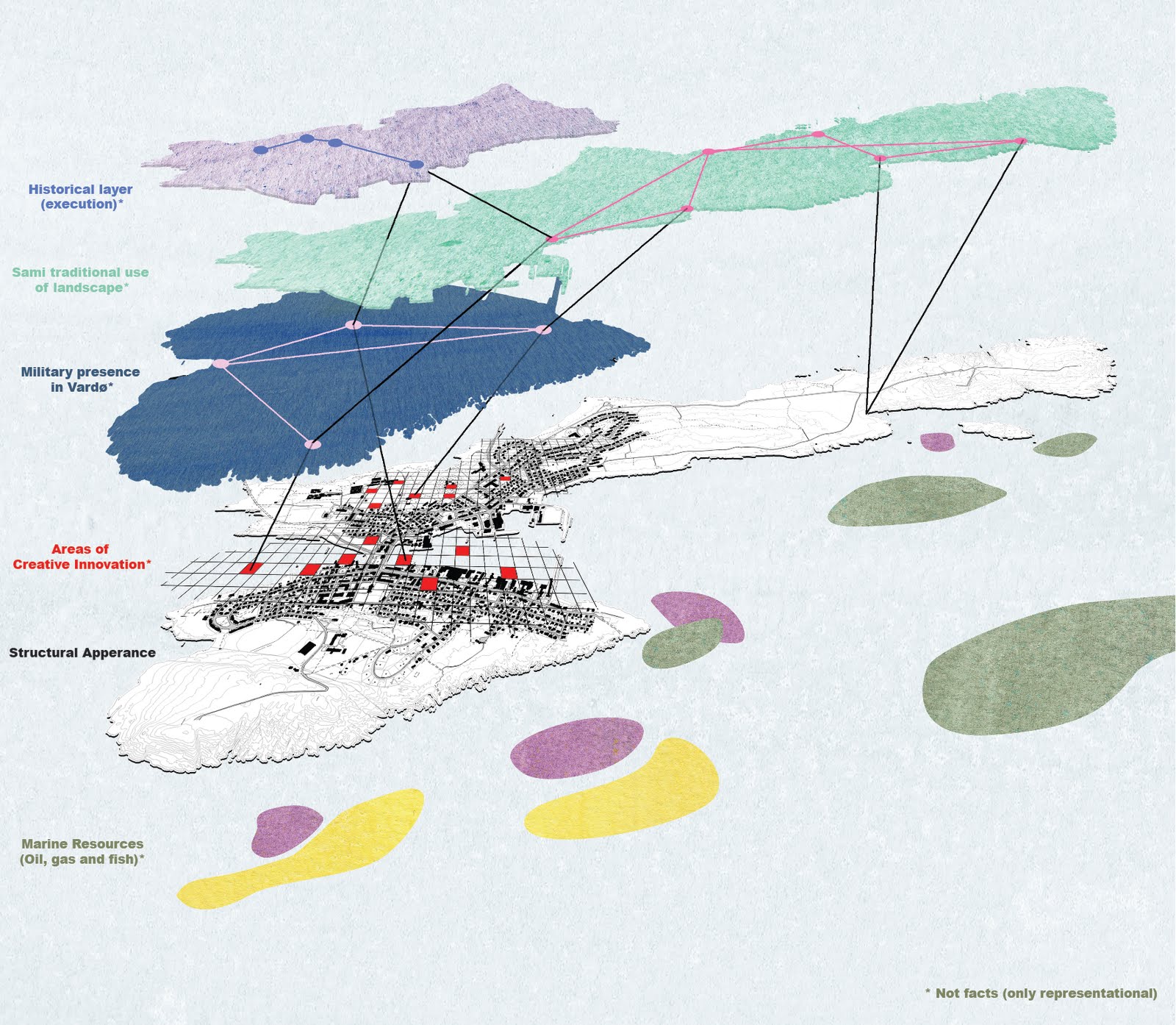 Understanding the interactions, conflicts and historical trajectories in Vardø
 Gaining a new understanding of space in use seen from the point of view of the Sami population.
 Internal Urbanism in Murmansk as a result of privatization of apartments.
The Mr. Pink project is a realization of the potential represented by the the wast amount of abandoned ground floor apartments.
Reflections: Capturing knowledge & culture
priorities to establish knowledge and competence in the arctic region. Many of the towns we visited were concerned about certain monoculture in the local society. One type of industry or job isn´t enough to sustain the population in small towns. The largest emigrating demographic group in Finnmark-region are young females that move away are between the age 19-30, in most cases to gain higher education or different form of social life in bigger towns south of Finnmark. But we also met some people that have or have been making iniatives to find and cultivate existing history and knowledge based on the locality.

Norway. By mapping out network of birdhides along the Varanger coast, they have built many birdwathcing facilities that offers access, shelter and view in Varanger´s nature. After this project became reality the increasment of foreign tourists was 40% that kept the local hotel
running in Vardø. The networks of birdwatching huts in Varanger is able to channel the traffic of the number of tourists. But it´s not only birdenthusiast that are the main users. Local schools have also had lectures for younger students there also.


In Murmansk, Evgeny Goman, has worked on plan for seven years to start a youth house. Until now the authorities have showed little interest to Evgeny´s socal project. He finally got a ground floor of a dwelling house for rent to setup this platform for realization of youth projects. Like with Pikene på broen, the youth house is dependent on inative money from various people and organisations. To make the youth house a reality the ideology of reusing and reconstruct from recycled material, an old piano for an example, to create space for management and creativity.
These are examples that are hands on and low budget compared to other industry in the region. In these cases there´s always a struggle to get a iniative investment money, to get the ideas in process. But this is also an example of local knowledge and culture can be captured in conditions that may take on geopolitical issues, accessibility to nature or activating youth in the social community. One might wonder if this kind of entrepenuership could be a model for other local communities in the Arctic region. How could this meet existing agriculture and the knowledge of the northern-norwegian farmer or fisherman? Could a network of local scale knowledge industries become profiteble for communities?
Monday, September 19, 2011


Bicycle reflections in Murmansk
A map from the future.

My reflections of Murmansk as a bicycle city.
The city is a linear city, with a north-south axis with a distance of approximately 17km, and an east-west axis between 1-4 km. The coastline that runs from north to south has no elevation, and a bicycle route could link the city´s 3 separate district together.
Murmansk is not a dense city, it is oversized compared to the amount of people and trafic, and adding bicycle paths could be easily implemented without disturbing the remaining trafic. The buildings stands separated from each other, and it would be possible to create a more flexible and dynamic infrastructure by adding a diagonal bicycle grid, that runs between the buildings.


Tuesday, September 13, 2011
review #1 - Landscapes in Change / intro #2 - Vulnerability
Tuesday September 20 starting at 9.00, we'll review all your Landscapes in Change assignments:
expectations: define an expectation to the landscapes and/or cultures we will travel
observations: Spatial practices 1
-observations of spatiality and spatial practices at the locations we are visiting – for all to be observed at every lieu, but assignments are divided as follow:
-Hammerfest: Erlend / Jóna
-Alta: Dan / Yulia
-Kautokeino: Simeon / Terese
-Karasjok: Pétur / Niklas
-Vardø: Marianne / Mikkel
-Kirkenes: Robert / Silje
-Murmansk: all…
reflections: Spatial practices 2
-reflections on change..
Wednesday September 21 starting 9.00 we'll introduce next theme: Vulnerability.
expectations: define an expectation to the landscapes and/or cultures we will travel
observations: Spatial practices 1
-observations of spatiality and spatial practices at the locations we are visiting – for all to be observed at every lieu, but assignments are divided as follow:
-Hammerfest: Erlend / Jóna
-Alta: Dan / Yulia
-Kautokeino: Simeon / Terese
-Karasjok: Pétur / Niklas
-Vardø: Marianne / Mikkel
-Kirkenes: Robert / Silje
-Murmansk: all…
reflections: Spatial practices 2
-reflections on change..
Wednesday September 21 starting 9.00 we'll introduce next theme: Vulnerability.
Subscribe to:
Posts (Atom)